
Middlesex Canal Association P.O. Box 333 Billerica, Massachusetts 01821
www.middlesexcanal.org
Middlesex Canal Association P.O. Box 333 Billerica, Massachusetts 01821
www.middlesexcanal.org
| Volume 64 No. 2 | February 2026 |
The Middlesex Canal Museum will soon be moving to this new location a 2 Old Elm Street in North Billerica.
The nearly complete building is pictured here in late August of 2025.
MCA Sponsored Events – 2026 Schedule
Winter Meeting: 1:00pm, Saturday, February 14, 2026
“The MC in Lowell: Towpath to Bike Trail”
Presenters: Doug Chandler and J Breen
Location: Lowell Public Library
Middlesex Canal Commission Meeting: 3:00pm, Thursday, March 19, 2026
Tentative - Official Notice will be sent out by MCC in early March.
Bike Tour South, 11:15am, Sunday, March 29, 2026
Meet at the Lowell Train Station.
Leaders, Dick Bauer and Bill Kuttner
The 11:15 time will change with the MBTA Lowell Line schedule.
Note: The MBTA will not run trains at North Station on Jan 31, Feb 1, Feb 28, Mar 1, Mar 7, Mar 8, Mar 21, Mar 22, Mar 28, Mar 29, Apr 11 & Apr 12.
Spring Walk, 1:30pm, Sunday, April 12, 2026 (rescheduled)
Meet at the SE corner of the parking lot at the Woburn Cinemas
Leader: Robert Winters
Annual Meeting, 1:00pm, Saturday, April 25, 2026
“1st proprietor of the Middlesex Canal Corp., John Hancock”
Speaker: J. Breen
Location: Reardon Room of the Middlesex Canal Museum and Visitor’s Center
71 Faulkner Street, North Billerica, MA
24th Annual Bike Tour North, 9:00am, Saturday, October 3, 2026
Meet at the Middlesex Canal plaque right of the entrance to the Sullivan Square T Station, 1 Cambridge Street, Charlestown, MA 02129.
Leaders: Dick Bauer and Bill Kuttner
Fall Walk, 1:30pm, Sunday, October 18, 2026
Winchester – Medford
Fall Meeting, 1:00pm, Sunday, October 25, 2026
Speaker: TBA
Location TBA
Medford Historical Society, 1:00pm, Saturday, October 31, 2026
Talk on Middlesex Canal by J. Breen
TABLE OF CONTENTS
MCA Sponsored Events / Directions to MCA Museum and Visitors’ Center
President’s Message: “Substantial Derogation” – by J. Breen
Thank you from the MCA Treasurer Russ Silva
News from Betty Bigwood
“We have Heat at 2 Old Elm!”
“How We Going to Pay for Services at 2 Old Elm?”
“Progress at 2 Old Elm Street”
“David Allan Fitch” by Betty Bigwood
“Boulder with Rope Grooves at the Ox Bow” by Howard Winkler
Editors’ Letter
Dear Readers,
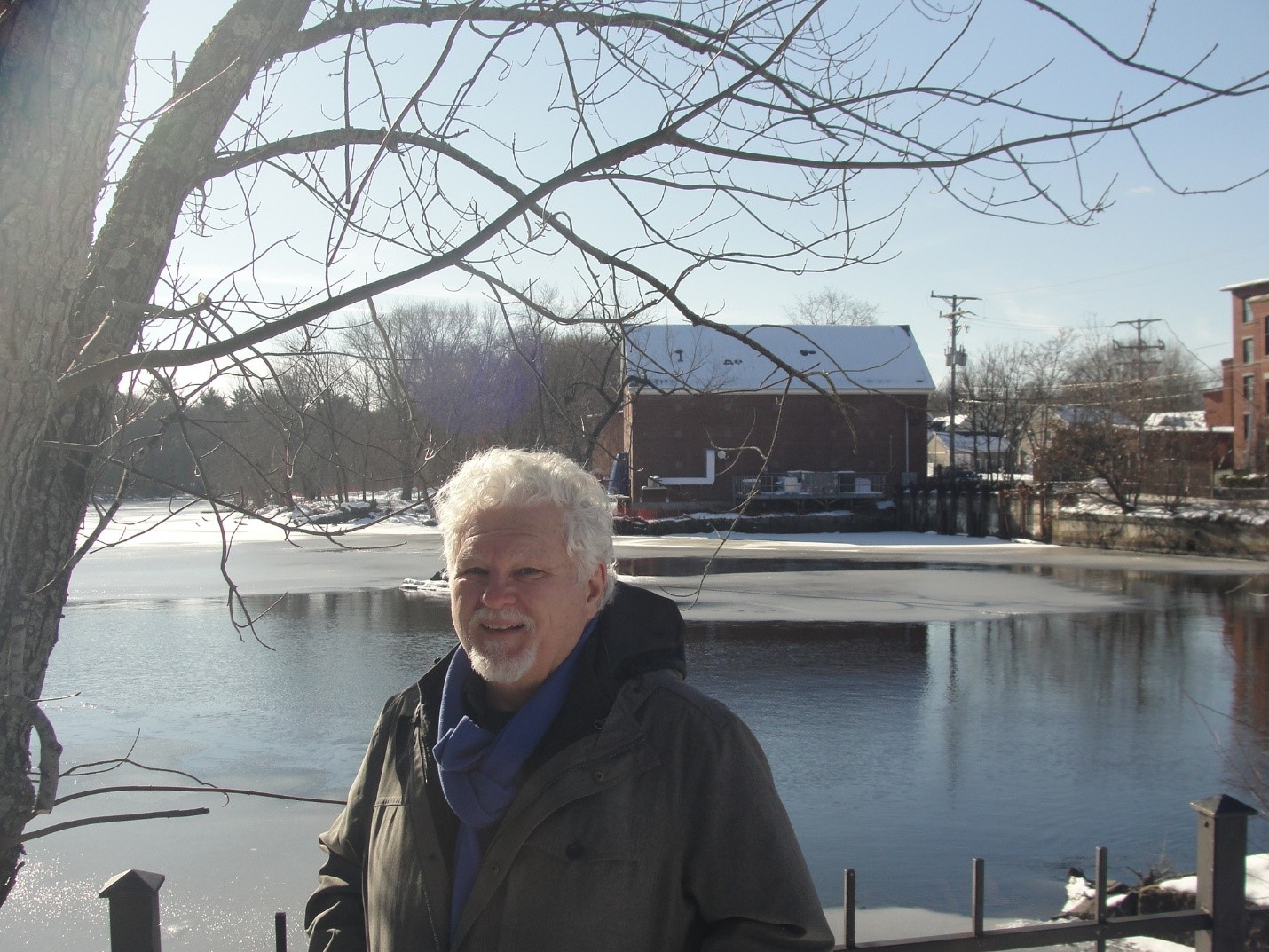
Welcome to the first Towpath Topics issue of 2026! Please note the cover photo of former President David Fitch at a site overlooking the future Canal Museum in North Billerica. Betty Bigwood has written a tribute to David and reveals his donation to the Museum.
In this issue President of the Association, J Breen, has outlined a justification for the non-demolition of the North Billerica Dam. Judgement was still pending at press-time. Russell Silva, Treasurer of the Annual Giving fund shares an update and thank you for donations. Howard Winkler has contributed photos and suggests a mystery/crime around the disappearance of the ox-bow boulder. What do you think?
Rounding out the issue, Betty Bigwood has sent updates on the 2 Old Elm new museum site progress and pitfalls and your editors have provided answers to the last issue’s canal quiz.
As usual, check the events schedule for dates and times of late winter not-to-be-missed “happenings.”
Your Editors
MCA Sponsored Events
Public Meeting, Saturday, Feb 14, 2026, 1pm – Towpaths to Bike Paths
Canal towpaths are as good as railroad tracks for conversion to multi-use bike and walking trails. Our own local historic Middlesex Canal can provide the connecting links bridging the gap between existing rail trails to Boston, Framingham, and Newburyport. Speaker will be Doug Chandler, a proprietor of the Middlesex Canal Association and a member of the State’s Middlesex Canal Commission.
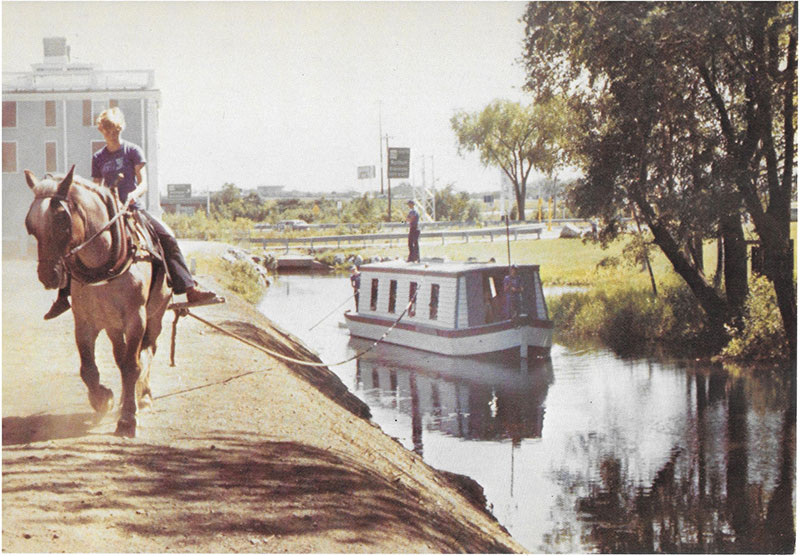
The talk will be at the winter meeting of the Association, hosted by the Pollard Memorial Library (401 Merrimack St, Lowell, behind City Hall) in the ground floor community meeting room. For more information: www.middlesexcanal.org and https://lowelllibrary.org/events/.
Note: Please consult the MCA website, www.middlesexcanal.org, for more detail on the walks, bike rides and meetings.
The Visitors’ Center/ Museum is open Saturday and Sunday, Noon-4:00pm, except on a holiday (Easter). The MCA Board of Directors meets the 1st Wednesday of each month at 3:30pm, except July and August. Check the MCA website for updated information. After October 1, 2025, the Museum will be closed for a few weeks while the displays are moved from the current location to the new building at 2 Old Elm Street in North Billerica.
Directions to Museum: 71 Faulkner Street in North Billerica, MA
By Car
From Rte. 128/95
Take Route 3 (Northwest Expressway) toward Nashua, to Exit 78 (formerly Exit 28) “Treble Cove Road, North Billerica, Carlisle”. At the end of the ramp, turn left onto Treble Cove Road toward North Billerica. At about ¾ mile, bear left at the fork. After another ¼ mile, at the traffic light, cross straight over Route 3A (Boston Road). Go about ¼ mile to a 3-way fork; take the middle road (Talbot Avenue) which will put St. Andrew’s Church on your left. Go ¼ mile to a stop sign and bear right onto Old Elm Street. Go about ¼ mile to the bridge over the Concord River, where Old Elm Street becomes Faulkner Street; the Museum is on your left and you can park just beyond the bridge in the lot on your right. Watch out crossing the street!
From I-495
Take Exit 91 (formerly Exit 37) North Billerica, then south roughly 2 plus miles to the stop sign at Mt. Pleasant Street, turn right, then bear right at the Y, go 700’ and turn left into the parking lot. The Museum is across the street (Faulkner Street). To get to the Visitor Center/Museum enter through the center door of the Faulkner Mill and proceed to the end of the hall.
By Train
The Lowell Commuter line runs between Lowell and Boston’s North Station. From the station side of the tracks at North Billerica, the Museum is a 3-minute walk down Station Street and Faulkner Street on the right side.
President’s Message
“Substantial Derogation”
by J. Breen
On December 18, 2025, the Lowell Sun published a front page report, “Historic Districts Commission told to revisit vote”, on the Northern Middlesex Council of Governments (NMCOG) review of Billerica’s Historic Districts decision to refuse permission to the owner of the Billerica Falls Dam to demolish it. The reporter, Peter Currier, did a fine job and most gratifying to canallers, included a color photo of the waterfall over the dam on the front page. However, the report lacked a sentence on the historical significance of the dam which required the Historic Districts Commission to refuse permission for the owner, CRT Realty Development LLC, to remove the dam. The Commission could grant permission only if permission would not involve “a substantial derogation from the intent and purpose” of the Historic Districts Act, M.G.L., Ch. 40C.
Removing the dam and draining the summit pond formed by the dam would be a huge derogation from the purpose for which Billerica Town Meeting established the Billerica Mills Historic District. What follows are a few facts for a sentence or two on the dam, John Hancock’s Middlesex Canal, and their historical importance.
1. The existing dam was built 198 years ago by the canal corporation to replace its first dam built in 1798 which was leaky. Also, the corporation was flush with cash from transporting bales of cotton, etc. to a booming Lowell and could afford to rebuild in the then gold standard for dams, granite, which would last for more than a hundred years.
2. The dam was built to supply water to the canal. The 1825 agreement between the corporation and Francis Faulkner, the mill owner in 1825, stated he may draw the pond down to 3/4” below the top of the dam and no further, the water below 3/4” being reserved for the use and purpose of the canal corporation. In other words, the corporation granted permission for the mill owner to use water above the 3/4” mark but not below where a lower level would effect canal boats floating in water a minimum of 3½’ deep.1
3. The board of directors of the Middlesex Canal Corporation sold the dam and mill privilege in 1851 to the Talbot brothers as part of the Corporation’s liquidation. To call it the Talbot Mills Dam is to ignore its history. Henry Thoreau in A Week on the Concord and Merrimack Rivers when boating between the rivers on the Middlesex Canal referred to the dam as Billerica Falls, identifying the historical name for the falls that were there before the first dam in 1710.
4. “The Middlesex canal, uniting the waters of [the Merrimack River] with the harbor of Boston, is however the greatest work of the kind which has been completed in the United States.” Report on Public Roads and Canals by the US Secretary of the Treasury to Congress, April 4, 1808. The canal was the first part of a water highway between Boston Harbor and Concord, NH. It made possible low cost transportation of thousands of bales of cotton to the new water powered mills of the Merrimack. Lowell could not have competed with the waterside mills of Dover, NH and Fall River if transportation was by horse and wagon. When the Corliss steam engine came into use, Fall River grew bigger, faster, than Lowell because Fall River had water transportation for cotton and coal.
5. The price of a yard of cotton cloth went from thirty cents to as little as six cents.2 Francis Cabot Lowell revolutionized American cotton manufacturing by integrating cotton-to-cloth manufacture in one building powered by water power. The low cost transportation of the existing Middlesex Canal made the new mills at Lowell practical. The large reduction in the cost of cotton clothing was likely the first part of the industrial revolution of the 19th century to affect most Americans.
6. The canal’s original purpose before the Industrial Revolution was exchanging agricultural products southward and manufactured & imported goods northward.
• This canal opened up the whole of central NH farming to reach higher priced markets in Boston and all its suburbs for lumber, firewood, grain, fruit, meat, hay, and all other agricultural products city folks needed.
• Likewise, early manufactured goods from more civilized Boston and imports by sea through the port of Boston could better reach an untapped market of rural customers.
• An example of the effectiveness of low cost transportation is the building of the Chelmsford glassworks in 1802, built when the canal reached the Mystic River. Sand from New Jersey could be boated up the canal to where the forests of New Hampshire could be floated down the Merrimack and burned to melt the sand for 330,000 feet of window glass.3 A second example is the tanning industry founded in Woburn based on hides from around the world up canal to Woburn where tanbark could be floated down from New Hampshire.
Brief description of the canal in a sentence or two:
Begun in 1793 by John Hancock and his compatriots, the Middlesex Canal was the greatest work of its kind in the US until the Erie Canal. The canal was part of an eighty-mile water highway between Boston Harbor and Concord NH.
Or, with more detail:
Incorporated in 1793 with John Hancock as the first proprietor, the canal connected the Merrimack River at Lowell with the Charles River at Boston by a ditch 3½’ deep, 30’ wide, 27 miles long with eight aqueducts, twenty locks, and fifty bridges. It was the greatest work of its kind in the US until the Erie Canal, and its low-cost transportation of thousands of bales of cotton along with waterpower was the basis for the cotton mills of Lowell, Nashua, and Manchester. The canal operated for 50 years, until the one horsepower canal boat quickly lost to a new competitor, the 30 horsepower steam locomotive.
Notes:
The 1828 dam would be better named the Billerica Falls Dam on the authority of Henry Thoreau and the pond formed by the dam identified as the summit pond supplying water to the Middlesex Canal, 107’ above Boston Harbor and 26’ above the Merrimack, not as a mill pond.
Footnote 1:
And the said corporation do also grant by these presents unto said Faulkner, his heirs and assigns, the privilege of using the water which passes through one-half of the creek leading from the Mill- pond to the Fulling Mill in the channel as it now runs under the Mill now in the possession of said Faulkner, for the purpose of working said Mill and Factory as it now is connected therewith, whenever the exercise of such privilege shall not deprive the grantors or their assigns of an ample and sufficient supply of water at all times and for all purposes and occasions, not exceeding, however, the quantity which is or may be requisite for the Middlesex Canal, and to carry the grist-mills and saw-mills of said grantors as they now are, whether used by the grantors or others to whom they may choose to sell or dispose of the same, for the same, or any other purpose. And as there will not be such adequate quantity of water as is intended to be reserved for the use and purposes of said grantors, unless the water in the mill-pond when on a still level is at or within three-fourths of an inch of the top of the dam or flash boards as the same now exists on the main dam across Concord River, it is declared that unless the water in said mill-pond shall be at such height, to be determined by a standard to be placed in a still and quiet part of the pond, upon which the present height of the dam and flash boards shall be marked and a mark also made at the distance of three-quarters of an inch below the height of said dam and flash boards, said Faulkner shall not have a right or privilege to use said water for any other purpose. Excerpt from the agreement recorded May 5, 1825 in the now South Middlesex Registry of Deeds, book 260, pp. 48 - 53. Transcription in / Report of the Joint Special Committee Upon the Subject of the Flowage of Meadows on Concord and Sudbury Rivers, January 28, 1860 / [451-517pdf]. Boston: William White, printer to the State, 1860. Available online by Google Books.
Footnote 2:
Robert C. Winthrop, /Memoir of the Hon. Nathan Appleton, LL. D. Boston: John Wilson and Son, 1861. Page 23 (35-96pdf).
Footnote 3:
Dorit Lammers, German Glass Blowers in Chelmsford. Chelmsford, 2005. History of Chelmsford by Wilkes Allen. Haverhill: P.N. Green, 1820. Glass factory, p. 75.
Thank you from the MCA Treasurer Russ Silva
Thank you to those who responded to the Annual Appeal.
The Middlesex Canal Association’s thanks go to the forty-one individuals who, as of Friday, January 16th, have donated $4,365 to the 2025 Annual Appeal. This includes $1,890 to the Building Fund and $110 to the Endowment Fund. The rest will be applied to Current Expenses.
The number of donors and the total amount given to the appeal is about the same as last year. In addition, there were donations from three “Donor Advised Funds” one of which was for $1,000 which also arrived during this time.
And again, throughout the past year, one of our largest contributors donated a significant amount to the 2 Old Elm Museum Building renovation project directly instead of through the Appeal. Thanks to them, once more for their generosity.
If anyone else wishes to send a contribution in any amount at any time for the benefit of the Endowment Fund, the New Museum/Building Fund, or the “General” Fund for Current Expenses, please do, and thank you.
Russ Silva, Treasurer.
News from Betty Bigwood:
We have Heat at 2 Old Elm!
In the Fall, one half of the heating unit - a replacement fan - arrived damaged and had to be returned. Kayla Murphy, Project Manager, for New England Cooling Towers was unable to speed up the delivery. Although repeated calls were made it was not delivered until Christmas time. Several months passed - waiting - in fact it was the longest delay any of us had seen. All work was stopped: carpentry, painting, flooring etc. Finally on Wednesday, January 14, 2026 the heat was turned on and we started again. We are still waiting for bespoke duct work for the kitchen hood from the same firm. Hopefully it will arrive soon.
How are We Going to Pay for Services at 2 Old Elm?
At the present time there are three ways to pay our way.
(1) Annual Appeal: An initial letter is written by J Breen and Betty Bigwood and sent to Howard Winkler. Neil prepares the address labels and sends them to Howard. Howard puts it all together and mails them. Russ collects the proceeds and deposits the money. Please see his article where he details his activities.
(2) Endowment Fund: This is a future resource as we cannot withdraw interest until the total reaches $500,000. We need to work on this. Our future depends on it.
(3) Rental of the Museum: We are in the process of making a commercial kitchen to allow rentals. The Billerica Board of Health has very specific regulations. The hood over the stove has proven to be complicated and we will need four additional main appliances: stove, refrigerator, dishwasher, and sink. I am currently working on the three basin sink from United Restaurant Equipment in North Billerica with “George” and the BOH.
Progress at 2 Old Elm Street
I received a very frustrated phone call from contractor Bill Cogley saying he had spent 6 hours trying to get the last-minute signoffs to complete the Occupancy Permit for us to move into 2 Old Elm. (1) The water department was very prompt and gave out an inspection sticker but wanted Fred Russel from the DPW to give his permission first. (2) No sign off from the Plumber who needs to certify that the sewer system works - he needs the water permit first. (3) Matt Hammer is working on the “As is” plans for the Sewer Connection. (4) Mark Farmer, who dug the sewer connection is working with Fred Russel of the DPW to arrange for the 300 ft of asphalt to be laid down in the spring with warmer weather. There is a lot of coordination still pending. In the meanwhile, Isabel Reardon has updated the inventory of the museum and met with the fire department for placement of signage over the street door and placement change of the carved wooden sign at the 71 Faulkner entrance. Direct Verizon phone-lines have been installed at the sprinkler system and the platform lift as well as agreements with a monitoring surveillance company to verify that contacts were made. It gets complicated.
Meanwhile winter has set in with at least 24 inches of snow. More is on the way!
David Allan Fitch
by Betty Bigwood
Attorney David Allan Fitch, a past President of the Middlesex Canal Association (1987-1990), is ending his long-term practice in Lexington. In early January he asked if we would like his office furniture for our new museum. We gratefully accepted. On Friday, January 23, our President J met him at 10am at 71 Faulkner St. The movers quickly placed the red leather suite and other gifts in the Reardon room.
David is now 73 years old, the father of three and proud grandfather of two curly haired youngsters (ages 4 & 6 years old). He and Janet purchased a home in Peterborough, NH two and a half years ago in anticipation of retiring there. He has grown tired of the long commute.
After college, uncertain of his future career, he spent two years in Iceland working on the fishing boats. Not many future attorneys entering Harvard Law School have proficiently in Icelandic on their curriculum vitae.
I remember many meetings of the MCA around his dining room table in Billerica. After his presidency of the MCA, he became involved with the Billerica Historic District Commission - both the founding and on the board. He was particularly kind to Colonel Hoxie during his long stay in a retirement home and with his estate planning. We wish David well in his retirement.
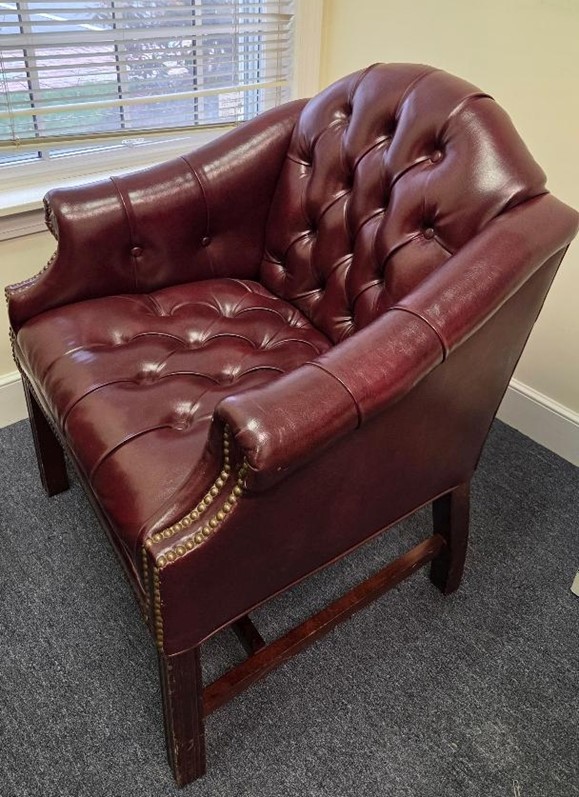
Leather chair donated by David Allan Fitch, ESQ on January 23, 2026
Boulder With Rope Grooves at the Ox Bow
by Howard Winkler
The boulder with rope grooves at the Ox Bow was removed in the late 1990s. This boulder and the rock ledge adjacent to it bore erosion grooves caused by the canal boat to horse towline that was dragged across them for five decades. Figure 1 shows rope marks on the boulder.
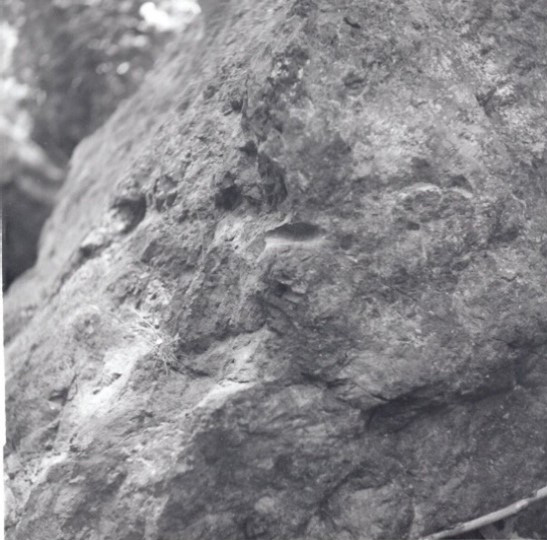 Figure 1 |
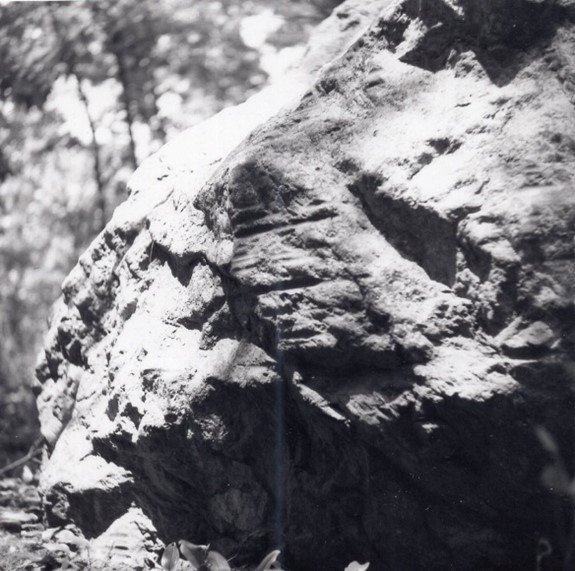 Figure 2 |
The rope marks on the ledge are to be seen in Figure 2.
The Ox Bow was created by the need to skirt a swampy area. It was not possible to fill the swamp so it could support an embankment. Since the canal builders could not go through the swamp, they went around.
The Ox Bow is shown in Figure 3.
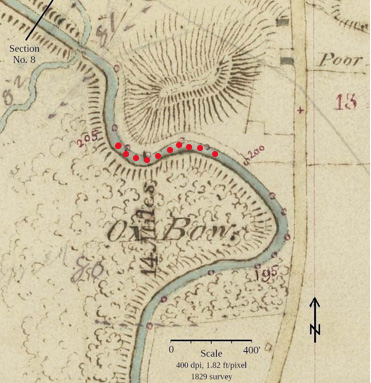
Figure 3
The tiny circles drawn in the canal bed is the place where towlines formed the grooves. The geometry was such that the boulder and ledge came between the horse and boat.
It is not clear to this author why the builders did not blast the boulder and ledge away. By not doing this, the builders left an interesting artifact, and something for me to write about.
When the missing boulder came to the attention of past President Burt VerPlanck and then President Nolan Jones, they spent a fruitless afternoon searching for it.
What happened to the boulder? I have three theories.
1) A flash flood raced through the canal bed and plucked the boulder off the embankment and the force of water moved it on to Route 38 where it rolled away.
2) A bolt of lightning struck the boulder and caused it to disintegrate.
3) It was moved by the Wilmington Public Works Department and placed in the back yard of a Wilmington official where the family enjoys it. Ordinary citizens do not own front end loaders and flatbed trucks that would be needed to cause its disappearance.
Which one of these theories do you the reader think is most likely? If you have your own, please let me know.
Editors’ Quiz: Answers to the quiz in the previous issue
Towpath Topics is packed with information about the Middlesex Canal that cannot be found elsewhere. If you can answer these questions, you will not win a prize, but you are an avid MCA newsletter reader. If you cannot answer them, they can all be found in back issues of Towpath Topics which were archived on the Middlesex Canal Association website by webmaster, Robert Winters.
MISCELLANY
Back Issues – More than 60 years of back issues of Towpath Topics, together with an index to the content of all issues, are also available from our website http://middlesexcanal.org/towpath. These are an excellent resource for anyone who wishes to learn more about the canal and should be particularly useful for historic researchers.
Estate Planning – To those of you who are making your final arrangements, please remember the Middlesex Canal Association. Your help is vital to our future. Thank you for considering us.
Membership and Dues – There are two categories of membership: Proprietor (voting) and Member (non-voting). Annual dues for “Proprietor” are $25 and for “Member” just $15. Additional contributions are always welcome and gratefully accepted. If interested in becoming a “Proprietor” or a “Member” of the MCA, please mail membership checks to Neil Devins, 28 Burlington Avenue, Wilmington, MA 01887.
Middlesex Canal Association Officers and Directors: http://www.middlesexcanal.org/directors.htm
Museum & Reardon Room Rental – The facility is available at very reasonable rates for private affairs, and for non-profit organizations to hold meetings. The conference room holds up to 60 people and includes access to a kitchen and restrooms. For details and additional information please contact the museum at 978-670-2740.
Museum Shop – Looking for that perfect gift for a Middlesex Canal aficionado? Don’t forget to check out the inventory of canal related books, maps, and other items of general interest available at the museum shop. The store is open weekends from noon to 4:00pm except during holidays.
Web Site – The URL for the Middlesex Canal Association’s web site is www.middlesexcanal.org. Our webmaster, Robert Winters, keeps the site up to date. Events, articles and other information will sometimes appear there before it can get to you through Towpath Topics. Please check the site from time to time for new entries.
The first issue of the Middlesex Canal Association newsletter was published in October, 1963.
Originally named “Canal News”, the first issue featured a contest to name the newsletter. A year later, the newsletter was renamed “Towpath Topics.”
Towpath Topics is edited and published by Debra Fox, Alec Ingraham, and Robert Winters.
Corrections, contributions and ideas for future issues are always welcome.
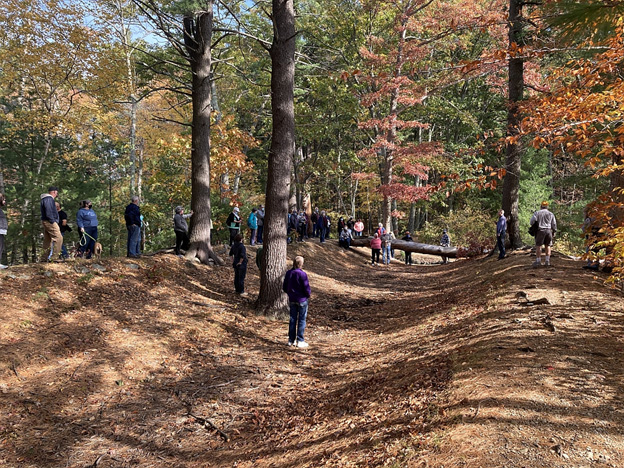
The remains of the Middlesex Canal prism in Wilmington, Massachusetts