
Middlesex Canal Association P.O. Box 333 Billerica, Massachusetts 01821
www.middlesexcanal.org
Middlesex Canal Association P.O. Box 333 Billerica, Massachusetts 01821
www.middlesexcanal.org
| Volume 65 No. 1 | October 2026 |

Andrew (Andy) J. Bowen, Jr. (1933-2026)
MCA Sponsored Events – 2026 Schedule
Fall Walk, 1:30pm, Sunday, October 18, 2026
Winchester – Medford
Meet at Shannon Beach parking lot, Mystic Valley Parkway
Fall Meeting, 1:00pm, Saturday, October 24, 2026
“Lowell and John Hancock’s Middlesex Canal”
Speaker: J. Breen
Medford Historical Society, 1:00pm, Saturday, October 31, 2026
“Medford and John Hancock’s Middlesex Canal”
Speaker: J. Breen
TABLE OF CONTENTS
MCA Sponsored Events / Directions to MCA Museum and Visitors’ Center
President’s Message: “Lowell’s Western Canal” – by J. Breen
Thoughts from Chair of the Middlesex Canal Commission – by Andrew Jennings
“Random Thoughts and Impressions” – by Bill Gerber
“Andy Bowen’s Obituary and Tribute” – Shayne Reardon and Betty Bigwood
“Crossing the Street” – Shayne Reardon and Betty Bigwood
“An Act for Incorporating the ‘Proprietors of the Middlesex Canal’” – Howard Winkler
Editors’ Letter
Dear Readers,
Welcome back to Towpath Topics for the Fall 2026 edition.
Sadly we note the passing of a favorite Billerica resident, Andrew Bowen. Always available to lend a hand or make a donation to fix a problem, he will be greatly missed. Shayne Reardon and Betty Bigwood have supplied further tributes to him.
The new museum at 2 Old Elm Street, North Billerica is nearing completion. Check out the photos of the signs and clean-up, again provided by Shayne and Betty.
Howard Winkler has contributed the next submission. It is the document incorporating the Proprietors of the Middlesex Canal. The editors believed it was important to have this document part of the official Towpath Topic permanent archive, and it is also important to occasionally look back to see where it all started.
Lastly, we have a contribution from former editor Bill Gerber. He takes us on a journey through his history with canals and the interesting adventures that he met up with along the way. The editors would also like to thank Bill publicly for always providing us with articles when we are searching for more Towpath Topics content.
The President’s Message from J. Breen provides an interesting view of the canal system in Lowell and thoughts from the chair of the Middlesex Canal Commission, Andrew Jennings, round out this edition.
Please check out the calendar and directions to the museum and the “Back Page” for resources. Letters, comments, and articles are always welcome.
The Editors
MCA Sponsored Events
Fall Meeting: The Middlesex Canal Association’s Fall Meeting will be held at 1:00pm on Saturday, October 24, 2026 in the Reardon Meeting Room at the Middlesex Canal Museum and Visitors Center, 71 Faulkner Street, North Billerica MA 01862. J. Breen, President of the MCA, will speak on “Lowell and John Hancock’s Middlesex Canal” with emphasis on the city landing and the remnant towpath and locks of the Western Canal.
Medford Historical Society Meeting: This meeting will be held at 1:00pm on Saturday, October 31, 2026 in Bonsignore Hall at the Medford Public Library, 111 High Street, Medford, MA 02155. J. Breen, President of the MCA will speak on “Medford and John Hancock’s Canal” with emphasis on the significance of the canal as part of an interstate water highway system essential to the Industrial Revolution in Massachusetts.
For more information on the MCA meetings, bicycle rides and canal walks please access the MCA website, www.middlesexcanal.org.
The Visitors’ Center/ Museum is open Saturday and Sunday, Noon – 4:00pm, except on a holiday (Easter). The MCA Board of Directors meets the 1st Wednesday of each month at 3:30pm, except July and August. Check the MCA website for updated information as at some time in the near future the Museum will be closed for a few weeks while the displays are moved from the current location to the new building at 2 Old Elm Street in North Billerica.
Directions to Museum: 71 Faulkner Street in North Billerica, MA
By Car
From Rte. 128/95
Take Route 3 (Northwest Expressway) toward Nashua, to Exit 78 (formerly Exit 28) “Treble Cove Road, North Billerica, Carlisle”. At the end of the ramp, turn left onto Treble Cove Road toward North Billerica. At about ¾ mile, bear left at the fork. After another ¼ mile, at the traffic light, cross straight over Route 3A (Boston Road). Go about ¼ mile to a 3-way fork; take the middle road (Talbot Avenue) which will put St. Andrew’s Church on your left. Go ¼ mile to a stop sign and bear right onto Old Elm Street. Go about ¼ mile to the bridge over the Concord River, where Old Elm Street becomes Faulkner Street; the Museum is on your left and you can park just beyond the bridge in the lot on your right. Watch out crossing the street!
From I-495
Take Exit 91 (formerly Exit 37) North Billerica, then south roughly 2 plus miles to the stop sign at Mt. Pleasant Street, turn right, then bear right at the Y, go 700’ and turn left into the parking lot. The Museum is across the street (Faulkner Street). To get to the Visitor Center/Museum enter through the center door of the Faulkner Mill and proceed to the end of the hall.
By Train
The Lowell Commuter line runs between Lowell and Boston’s North Station. From the station side of the tracks at North Billerica, the Museum is a 3-minute walk down Station Street and Faulkner Street on the right side.
President’s Message
“Lowell’s Western Canal”
by J. Breen
The Western Canal was laid out in 1825 by George R. Baldwin and completed in 1832 with the Suffolk, Tremont and Lawrence Mills built using the Western as part of a water highway connected to Boston via the Middlesex Canal. The 27-mile Middlesex, completed in 1803, made possible a transportation cost competitive with other mills using water transportation. After two hundred years, the remnants of the canal boat towpath and the locks for raising and lowering the boats over the 15’ height between the upper and lower levels of the Lowell power system are are still visible. See the following notes:
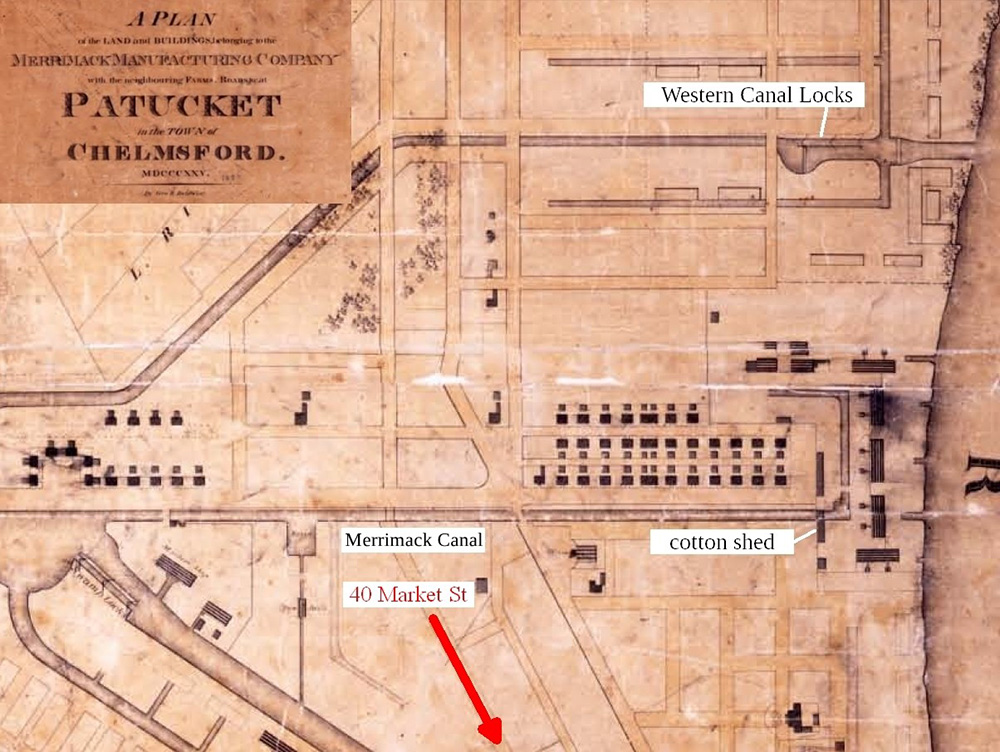
Detail of Baldwin’s MDCCCXXV plan, edited by the author, with detail of cotton shed located over the Merrimack Canal for hoisting bales.
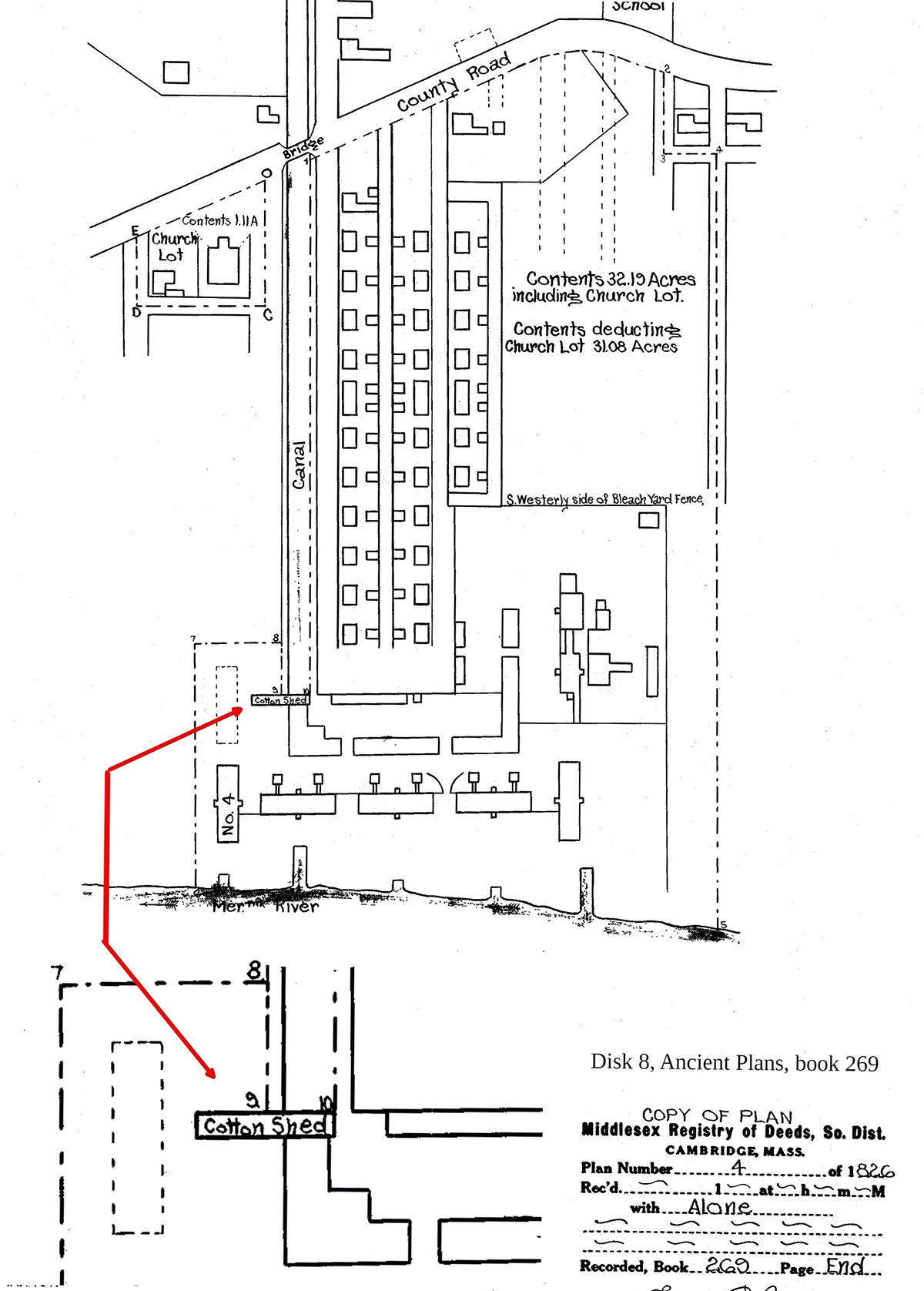
Plan No. 4 of 1826, South Middlesex Registry of Deeds.
Date of completion of Western Canal, 1832. Page 37 of Miles, Henry A. (Henry Adolphus), 1809-1895. Lowell, As it Was, And As it Is.
Lowell: Powers and Bagley and N.L. Dayton, 1845.
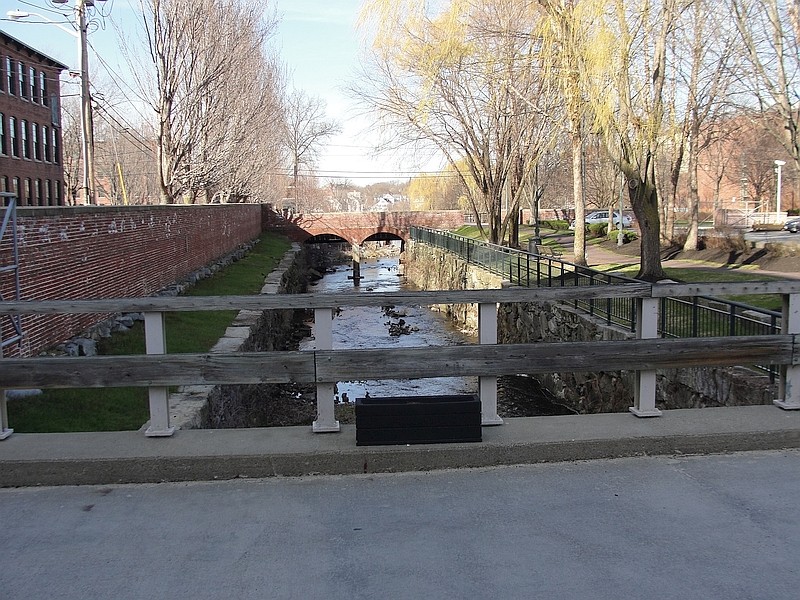
Western Canal looking north from the Tremont Gatehouse, towpath on the west bank; Wannalancit Mills and Suffolk St on left.
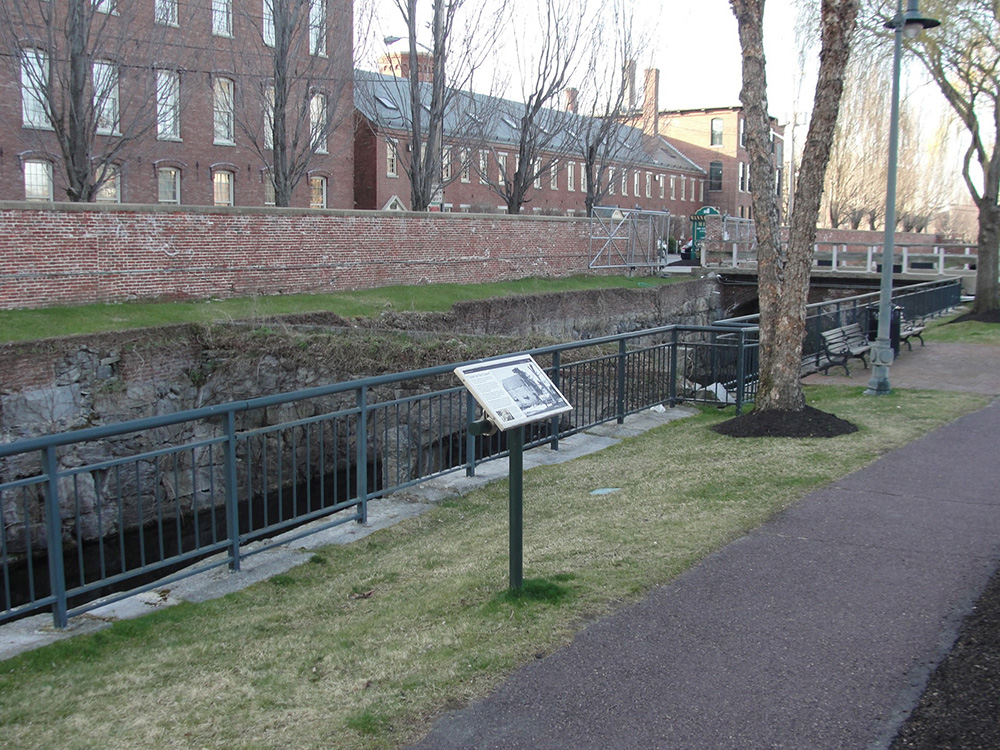
Sideview of towpath with interpretive panel on east bank
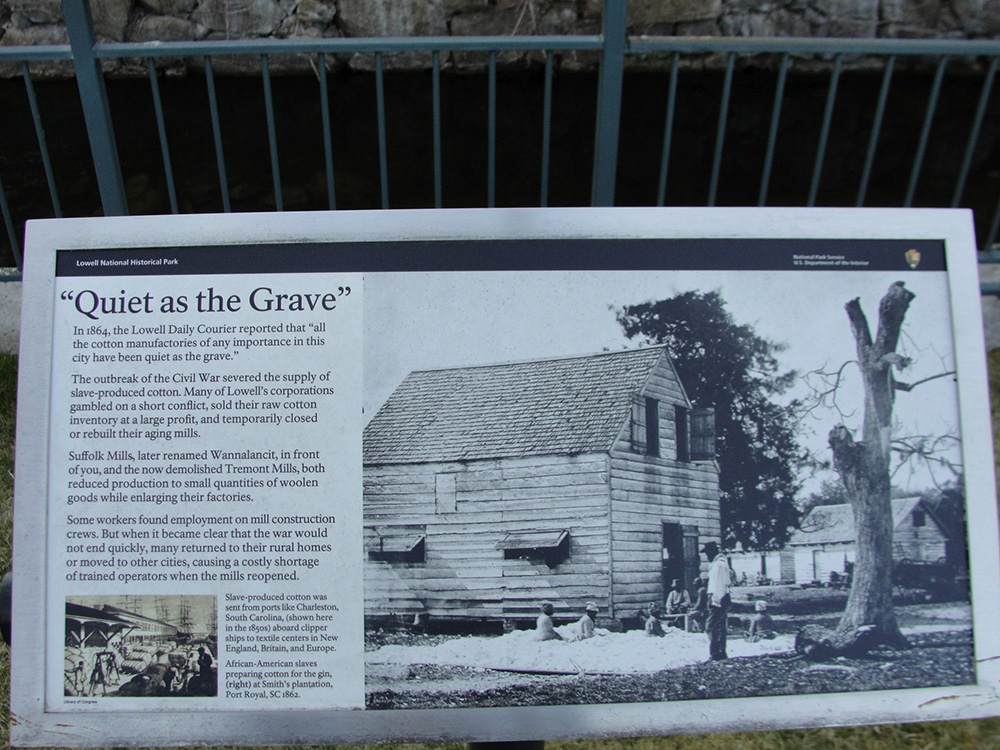
The panel ignores the 1832 towpath.
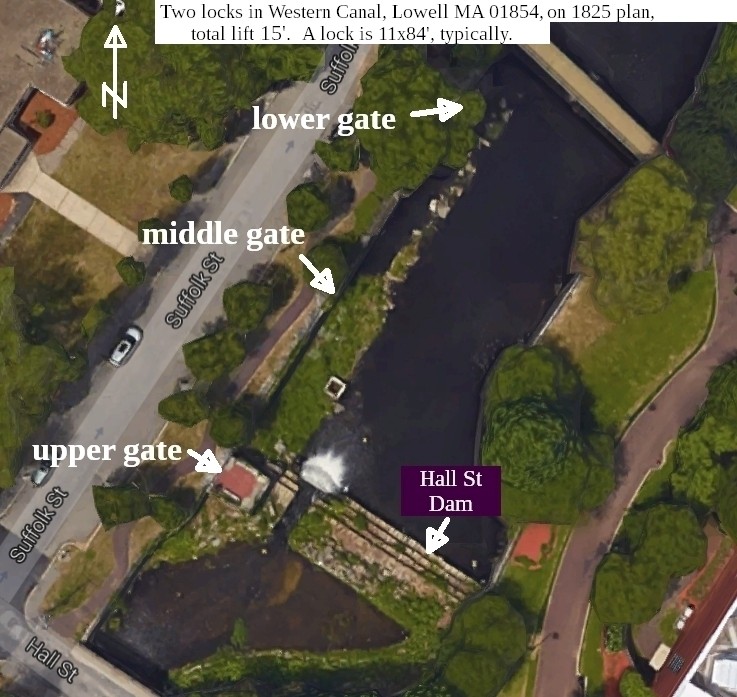
Remnants of locks in Western Canal.
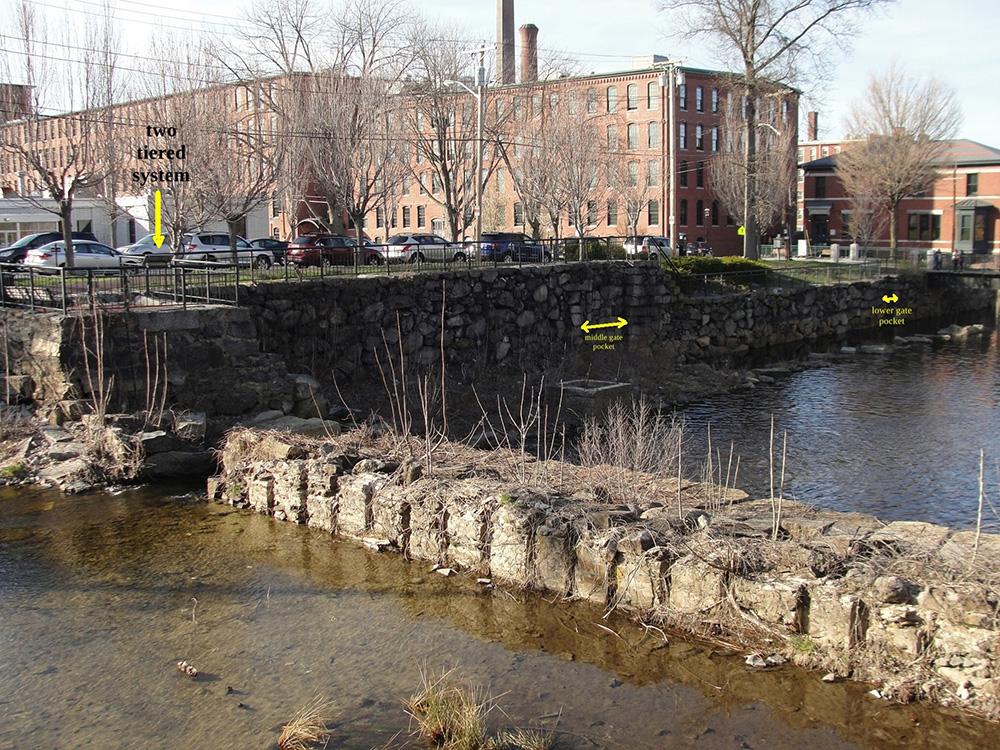
Locks with middle and lower gate pockets labeled.
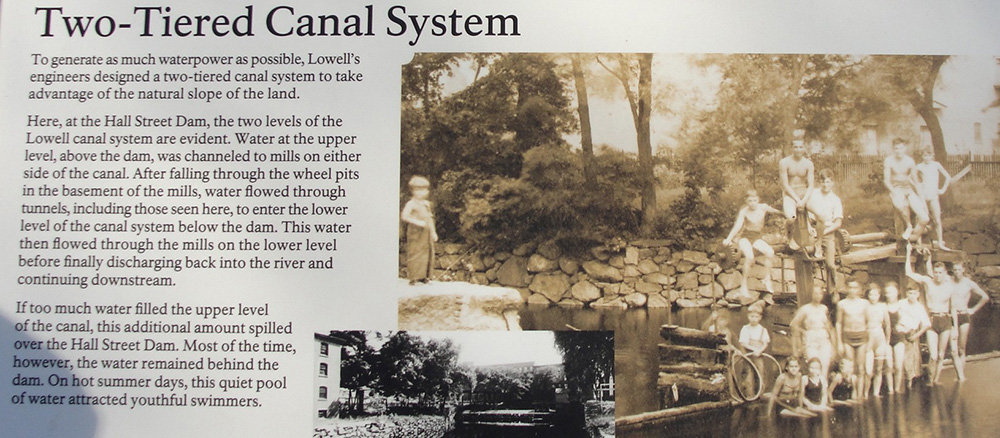
The interpretive panel on the two-tiered system ignored the locks.
Thoughts from Chair of the Middlesex Canal Commission
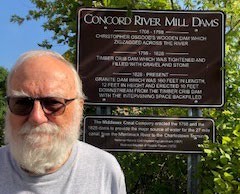 Let me give you a short introduction. My name is Andrew Jennings. I live in North Billerica not far from the summit pond of the Canal. I am a retired transportation consultant. I was elected chair of the Middlesex Canal Commission in March.
In the late 1970s and for most of the 1980s, I passed the dam and summit pond while walking to work. I enjoyed the changing views and the beauty of the spot. However it took me many years to learn that this was much more than an ordinary mill pond. It is one of the most important landmarks in US transportation history.
As most of you are aware this landmark is threatened. The dam owner has applied to remove the dam. This would of course not only eliminate the dam, but also drain the summit pond leaving a much different vista. The dam owner is supported by a group of non-profits who want to improve water quality and fish passage. The non-profits have had success removing a number of dams, but dams of much less historical importance.
The greatest danger to the preservation of what is left of the Canal is the lack of knowledge about the historical importance of the Canal by decision makers and the public. We need your help to keep the history of the Canal alive. I invite you to refresh your knowledge of the Canal and its contributions to the development of the region and the nation by revisiting the Canal Museum, and by reading some of the books, pamphlets, or articles about the Canal. After refreshing your knowledge, talk to your family, your neighbors, and your civic leaders about the importance of the Canal. Consider volunteering your time and talents to the Association or Commission. (The position of Vice-Chair of the Commission is open, and I know the museum could use more docents.)
I look forward to working with you to preserve the history of the Canal. That history should inspire the future. Thank you. Andrew Jennings
Random Thoughts & Impressions
by Bill Gerber
In The Beginning …
My interest in canals began in the early to mid 1970s. The first I encountered was the New Meadows Canal, built North and West of Bath, Maine to convey logs to saw mills west of Bath. It wasn’t much of a canal; it could only be used during the upper half of the tide cycle. I wrote about it in an article entitled ‘Twice-a-Day Island’. — My interest soon spread to the Cumberland & Oxford Canal that extended between Portland ME and Sebago Lake and on to Long Lake through the Songo River and Lock, and Brandy Pond. I wrote of two sunken C&O canal boats for a 1974 issue of American Canals, the newsletter of the American Canal Society. — While participating in a bicentennial reenactment (AEQ-’75) I met Fred & Cathy Lawson, was introduced to the Middlesex Canal and soon found myself on the Board of Directors. About that time I started ‘exploring’, then writing about, the Canals of the Merrimack River. — On a home visit to PA, I found a book on the Susquehanna & Tidewater Canal, the head of which was less than 15 miles from where I grew up. My reaction: until now, how come I’ve only ever heard about the Erie, the Panama and the Suez Canals? How many more canals are/were there? It was around that time that I met Bill Shank, then President of the American Canal Society; I was soon to discover, through the ages, there were MANY!
Continuing On …
By now I’ve been researching the Canals of the Merrimack, and the Middlesex and Mill Creek Canals for something on the order of 50 years. To share what I thought I’d learned, I’ve contributed just shy of 100 articles to Towpath Topics, the newsletter of the Middlesex Canal Association; still more if you care to include the Calendars that I assembled (about two dozen) and other miscellaneous stuff that I wrote during the eight years that I was the editor of TT; also the several articles for American Canals.
Winding Down …
As of earlier this year I’m a newly minted nonagenarian and probably don’t have many more articles left in me to contribute. However, during the time I was actively researching, I accumulated a number of impressions that I failed to pursue: a) I either never attempted to document, b) I couldn’t find sufficient, sometimes any, documentation to support publication, or c) for some other reason I just never got around to doing it. And so the thoughts and impressions that follow may or may not be correct. But, for the fun of it, allow me to tell some of these to you for your consideration, perhaps even to stimulate your research. In no particular order, here goes:
Making Ice …
The historical record indicates that the Middlesex Canal Company ran water through the entire length of the Middlesex Canal late in the day on December 31st,1803; in the dead of winter, during the time of a mini ice age. (Rumors are that they had to turn the clocks back in a few villages to make the claim that they had even managed that!!) What in the world were they thinking? Surely there is some rational explanation for this otherwise insane act.
I’ve never tried to verify this, and never seen documentation that I could use to do so, but I suspect that the reason is simple. In 1793 the Massachusetts Legislature gave the MCC 10 years to build the canal. In practical terms, the action should have been completed by the summer of 1803, but likely the legislature gave the company an extension until the end of the year to complete the project. Thus, I strongly suspect, the MCC undertook the insane action described above to meet the Legislature’s conditions, so as not to lose their legal authorization.
Frugal Beginnings …
With the exception of the Merrimack Flight of locks that connected the M’sex Canal with the Merrimack River, i.e., apparently the very first locks constructed on the M’sex Canal, the MCC Proprietors elected to build most of the rest of the canal structures - the locks, the aqueducts and their structural supports, bridges, lock keepers houses, Landings, etc. - primarily of wood. (In her book ‘Middlesex Canal’, Mary Stetson Clark observed: “To the dismay of Baldwin, locks were made of wood from 1799 onward, with the exception of intersections with rivers, and the lowest lock at Horn Pond” (Clarke p. 61-70). Between 1828 and 1837 nearly all of the Horn Pond Locks were rebuilt of stone. (Middlesex Canal Comprehensive Survey, 1999)) With this decision the Company traded reduced initial construction costs for higher life-time maintenance costs. Why would the Proprietors have made this decision? — It has long been my suspicion that the Proprietors were somewhat traumatized by the cost of building the Merrimack Flight of locks (of granite blocks, mortared with Loammi Baldwin’s version of hydraulic cement, which required importing a substantial quantity of a key ingredient), so they elected to build the rest of the canal structures primarily of cheap and readily available wood to constrain the costs of construction.
Special Need …
Red Lock, in Billerica, was added to the M’sex Canal in about 1838; that’s about three years after the Boston-Lowell RR opened, and began taking business away from the canal, and ominously about the time that RR was extended to Nashua, New Hampshire. Red Lock enabled canal boats to access and travel on the Concord River below the summit level dam. This raised the questions: why, serving what purpose, and why then?
Having assimilated a little of Lowell’s history over the years, I was aware of Mr. Whipple’s gun powder mill there on Centennial Island and I thought to myself: why ship gun powder behind a fire belching, wheel sparking locomotive when you could ship by water far from any ignition sources? Long after, a monograph turned up (*) that claimed: “Casks of powder produced at the works were shipped to Boston by wagon or by barge on the Middlesex Canal.” This document confirmed my suspicions. Absent any further documentation, I visited the lower Concord and the Centennial Island site a number of times to try to envision how this may have been done.
* https://www.lowellma.gov/DocumentCenter/View/14686/Whipple-Mill-LPCT
On the east side of Centennial Island, near the south end, there are remnants of a dam at the top of Wamesit Falls. The dam would have raised the water-level upstream of this point, but it would have barred canal boats from proceeding any farther on the river. — Also, there is a power canal that passes along the western side of the island, with a barrier also at the south end that bars travel into the canal, and so with the barrier, a strong current through that power canal and with no locks beyond, clearly, canal boats did not proceed beyond the south end of Centennial Island.
That leaves the southern end of the island as the likely point where boats were loaded. And, in fact, there is a substantial ‘straight edge’ of concrete there that (discounting the fish ladder that exists there now) looks attractive as a loading dock. I’m reasonably confident this is where Whipple’s gun powder was loaded. Canal boats would have departed the south end of Centennial, traveled up the Concord River to Red Lock, and entered the M’sex Canal at that point. But once in the canal, which way did they then go?
Instinct suggests the boats probably traveled down the canal. Their cargo might have been transshipped at the Mystic River in Medford, but more likely they proceeded on to Charlestown where the barrels or casks of gun powder could be transshipped. (I wonder how the people of the villages along the canal felt about boatloads of explosives routinely passing through.) In the monograph cited above there is mention of a warehouse in Salem that was used to store the powder; shipments might have been taken there on small sailing vessels from Charlestown.
However, it is not certain that the boatloads of powder went ‘down’ the canal. They might just as well have gone ‘up’, to Chelmsford’s Middlesex Village, locked down through the Middlesex Flight into the Merrimack River, traveled to and through the Pawtucket Canal, and proceeded on down the Merrimack (through multiple ‘improved rapids’ and the North Canal at Lawrence) to Newburyport. A shipment could have been transshipped to Salem from there, or from that point, the canal boat itself, or a number of them, might have been towed to Salem to be unloaded there.
Misleading Claims …
Claims are often made that ‘this pioneering waterway [the M’sex Canal] was completed in 1803 with pick-axes, shovels and blasting with gun powder.’ — I’ve long questioned this explanation, I think it is seriously misleading, at best.
To begin with, as noted above, water was run through the entire length (well into the night, I’ve been told) on December 31st, 1803 (the oral accounts claim that clocks had to be set back in some villages to enable even that claim!). That was FAR from completion! — Apparently the canal did begin operation sometime in 1804, no one disputes that. But in June of 1808 the Legislature passed an Act which allowed: “Three years from 22 June 1808 to complete the Canal to Charles River & to effectuate River”. And if one considers Nashua as the intended northern terminus of the M’sex Canal, which it was (not just the dug portion), then ‘completion’ must await erection of community/company built Landings at Dracut, Tewksbury and Nashua, and the opening of the channel and construction of the lock at Wicasee Island. I’m not sure when all of this was finished, but 1813/14, a decade later, looks to be a much more likely date for actual completion of the M’sex Canal.
Then there is the matter of the picks and shovels. The two shovels that we’ve had as part of the museum collection of artifacts are both ‘square-tipped’. (Tom Raphael provided an explanation of how shovels were constructed in those days in the January 2013 issue of TT.) But ‘square-tipped’ is hardly a shape for a shovel that is suitable for digging. If you were constructing a canal in those days, surely you’d have used a plow(s) to loosen the dirt, then those square-tipped shovels might well have been used to move loose earth, etc., to wherever you wanted it to go. Yes, picks, were undoubtedly used too, but a horse or oxen drawn plow would open so much more earth, so much more quickly than picks & shovels. (While researching for a revised version of his “Journey along the Middlesex Canal’, Roger Hagopian did find this statement: “This Pioneering waterway was completed in 1803, after 10 long years of planning and digging with such age-old tools as the horse-drawn plow, the pick, the shovel, the wheelbarrow, wagon, and special excavating carts.” Harley P. Holden from TT January 1966.)
How did the Materials Get There …
The Middlesex Canal, together with brick-makers, other manufacturers (e.g., water-power systems fabricators, e.g., Silver & Gay, in Chelmsford), and timber sources had prominent roles in providing the materials to construct the ‘miles of textile mills’ in Lowell, Nashua and Manchester; thereafter the canal transported cotton and other materials to those mills for many years. J. Breen, President of the M’sex Canal Association, identified the remains of Locks in Lowell through which many cargos of construction materials and later cotton no doubt passed. L.M. Lawrence tells us: “The Middlesex Canal profited by the growth of Lowell by transporting a large amount of bricks, lime, slate, and other materials of which the first factories, dwelling houses and other buildings were constructed.” And H.D. Thoreau, in A Week on the Concord and Merrimack Rivers, 1849, said: “From Bedford and Merrimack have been boated the bricks of which Lowell is made. About twenty years before, as they told us, one Moore, of Bedford, having clay on his farm, contracted to furnish eight millions of bricks to the founders of that city within two years. He fulfilled his contract in one year, and since then bricks have been the principal export from these towns. The farmers found thus a market for their wood, and when they had brought a load to the kilns, they could cart a load of bricks to the shore and so make a profitable day’s work of it. - So likewise, Manchester is being built of bricks made still higher up the river at Hooksett.” — Pretty obviously it was the profits from these transportation services that, by about 1828/29, enabled the M’sex Canal Company to rebuild much of the canal in stone.
Did He, or Did He Not …
In a statement in February 1820, John Langdon Sullivan, Agent (CEO) for the Middlesex Canal claimed “In the freshets, and generally, the steam towing boat has been very useful, being able to take two loaded boats against the current when they could not have moved at all…” He then said that at other times the steamboat could move the boats in half a day as far as they would have traveled in two days by ordinary means, and concluded that the boat had demonstrated the practicality of navigation through [New Hampshire and Vermont].” Sullivan made a similar statement in a letter to Thomas Jefferson about three years earlier. — Sullivan’s steam towboats towing canal boats on the Merrimack River in Massachusetts and New Hampshire are reasonably well known and documented (e.g., see ‘Sullivan’s Towboats’ in Towpath Topics for February 2010). However, why did Sullivan cite VT; certainly the Merrimack doesn’t go anywhere near there?
There are two explanations that I can think of. — I’ve never seen documentation of any kind that would support even the hint of this, but it has long been my suspicion that Sullivan, ever the salesman, took his late 1812 boat, the one equipped with the ‘warping windlass’, around to the Connecticut River and ascended Enfield Falls at what is now Windsor Locks, CT (the bypass canal there did not open until 1829). Once above these Falls, because the Connecticut River was canalized further up, Sullivan would have been free to continue up that river to VT. (However, Historical Connecticut River records claim that, in 1843, the Barnet was the first steamboat ever to ascend the river.)
There may be another explanation. At some point, perhaps around 1815, J.L. Sullivan and Samuel Morey began a constructive business cooperation. Morey, who lived along the Connecticut River in Orford, New Hampshire, was the inventor of the rotary steam engine that powered Sullivan’s 1818 boat, the Merrimack, and he may have influenced the design of the engine in Sullivan’s 1816 boat, And Morey, himself, experimented with steamboats there, also in nearby Lake Morey, long before he met Sullivan. But Samuel Morey was an inventor, to the best of my knowledge he did not run a company that employed steamboats. Nevertheless it may have been Morey’s experience that Sullivan was referring to. — It probably was the latter, but still, something keeps me wondering: did Sullivan take his 1812 boat up the Connecticut River, perhaps in 1813? Likely I will never know for sure!
How to Ascend a Flume …
In my article about the Canals of the Merrimack (TT, January 2009) I noted that Falls and rapids downstream from Lowell were ‘improved’ by the Pawtucket Canal Company. ‘Improved’ generally consisted of building a low wing dam across most of the breadth of the river and clearing rocks and boulders, perhaps blasting other obstructions, from a narrow selected area to facilitate passage. This would create a flume to effect passage. A flume was not a problem for rafts and boats traveling downstream. But the historical records suggest that occasionally boats ascended the river and thus would have had to ascend a flume at each of the improved sites they encountered. So how does one do that in a boat that probably was about nine feet in beam and 45 to 75 feet in length? I never learned the answer! Could one successfully ‘pole’ a boat against a flume? Or were there fixed lines installed at these ‘improved’ sites such that boatmen could employ some sort of windlass, perhaps manually operated but that worked similarly to the warping windlass on Mr. Sullivan’s late 1812 steam towboat? (See TT, February 2010). I never found evidence of fixed lines at any of the sites. But I went looking two centuries later; could anything of that nature have survived that long?
What’s It For …
Being constructed west of the existing Roark Bridge, the new bridge will cross/intersect a berm that parallels the north bank of the river. The berm extends for about half-a-mile upstream of the Merrimack Flight of locks. — Regrettably I never found any documentation to describe it, when it was built or its purpose. (See TT, January 2009, Locks and Canals of the Merrimack River, Undocumented Berm.)
My thought still is that the berm may have been constructed when the Pawtucket Dam was built and the basin by the lower lock of the Merrimack Flight, and part of that lock, were flooded by the lake that formed behind the dam. If so, then this berm on the opposite side of the river may have replaced the original basin, thereafter provided anchorage, for rafts and boats descending the river. Boats and bands of rafts could shelter in this protected space to await an opportunity to approach the lower lock, whenever the lock became available to receive them. In particular, ‘bands’ of rafts could have been disassembled there and taken across the river, one by one, to be ‘locked up’, raft by raft to the Concord River level.
This is my best guess; does anyone else have any other ideas about the purpose of the berm? Have any of you seen any references that might ’shed light on it’’?? I thought that Judge Samuel Hadley’s writings might have held a clue but I never detected any.
Andy Bowen (1933-2026)
Andy’s obituary, which did not appear in any newspaper, was written by his son, Scott, and daughter-in-law, Debbie, for the Burns Funeral Home in Billerica. This is followed by a tribute from Shayne Reardon.
Obituary of Andrew J. Bowen Jr.
Andrew J Bowen Jr, age 92, a Billerica resident of 63 years, died on August 3rd. Andy was the beloved husband of the late Patricia Bowen with whom he shared 48 years of marriage before her passing in 2009. Born on November 28, 1933 in Boston, Andrew was the beloved son of the late Andrew J. Bowen Sr. and Olga Miskevich. He graduated from Boston Technical High School and earned a BS in Mechanical Engineering from Northeastern University. After graduation, he enrolled in the Army and worked as a radar and computer technician. Andy was a retired engineer from MIT Lincoln Laboratory, where he worked for 42 years.
Andrew was highly involved in the Billerica community. He was a Town Meeting Member for 11 years and was also Cemetery Commissioner. He was an active member of the First Parish Church, Billerica Historical Society, and Middlesex Canal Museum. Andy was a Master Gardener graduating from the Massachusetts Horticultural Society program. His yard was his own garden center. He immensely enjoyed traveling and outings with family and friends. Above all, he loved doting on his two granddaughters, a constant presence at their roller skating, dance, band and color guard performances.
He is survived by his loving son and daughter-in-law, Scott and Debbie; his precious granddaughters, Jessica and Kaitlyn; his partner Susan Glennon; three sisters: Marsha O’Donoghue; Janet Whipple and Carol Miskevich. Andrew was also the brother of the late Jean Metz and Sandra Boehnke. He is also survived by many nieces and nephews; grandnieces and grandnephews and dear friends.
In lieu of flowers, donations can be made to the Billerica Historical Society, PO Box 381, Billerica, MA 01821 or The First Parish Church in Billerica, PO Box 96, 7 Concord Rd, Billerica, MA 0182. Graveside service will military honors be held Tuesday, August 11, in Fox Hill Cemetery, 130 Andover Rd., Billerica at 11:00am. Relatives and friends invited.
I had the pleasure of working with Andrew J. Bowen for many years in developing and building out the Middlesex Canal Museum. A more pleasant partner in coming up with ideas, writing, and requesting grants was not possible. Andy would take the public speaking portion and I would take the administrator portion of each presentation. He continued securing funding grants long after I was not involved. Plus, he was a willing helper and handyman around the Museum, participated in our parade processions for Yankee Doodle Day, as well as planting flowering trees on Lowell Street.
Andy Bowen’s main interest was signage around our town that would let people know where the canal ran, signage to the Museum from the Route 3 and in town (mostly funded by donations). Andy created an exhibit section of the Meeting Room to publicize the Narrow Gage Railroad and how its history fit within Billerica. He also developed a great exhibit “Chronology of the Concord River Dam, showing the history of the dam which was constructed in 1828. He continued to be an essential part of the volunteer group long after I retired.
Andy was nominated a Volunteer of the Year in Billerica, embarrassing his humble nature. That title is an understatement for all he did for the Billerica Section of the Middlesex Canal Museum and Town of Billerica.
Gratefully, Shayne
Debby Fox also wrote a Salute to Andy on his retirement in the September 2018 issue of Towpath Topics (Volume 57 #1).
Crossing the Street
by Shayne Reardon and Betty Bigwood
In June of this year, I telephoned Shayne to ask her help in moving the signs on 71 Faulkner Street to 2 Old Elm. She agreed. Shayne keeps excellent records and lucky for us, while the business “Top of the Line Sign Co.” had closed, the owner Scott Fortin had kept the same phone number. He agreed to stop by and assess the situation.
In order to acquire a Certificate of Appropriateness to move the blue Middlesex Canal Museum-Visitors Center sign across the street, Shayne had to submit paperwork to the Billerica Historic Districts Commission, which meets once a month to review and approve permits for all work on structures located in one of the four Billerica historic districts After receipt in July, she then met with the Director of Permitting Services, Mark LaLumiere for a building department permit, enabling the re-installation of our 24 year old Museum sign. Fortunately, the Town Manager waved the $100 fee. Permits for work must be posted at the site. August brought us brutal heat which delayed the effort. Scott spruced up the sign: He freshened up the blue paint, reinforced the back, put metal flashing over the top to keep water out and touched up the gold/black lettering. He hung it at the end of August. Shayne bought 3-inch black metal lettering and a four-inch numeral online in an acceptable script for the side entrance. Mr. LaLumiere approved it and Scott made a template to position the address over the entrance and screwed them in. He did all this for $385. His generosity of time and talent are much appreciated.
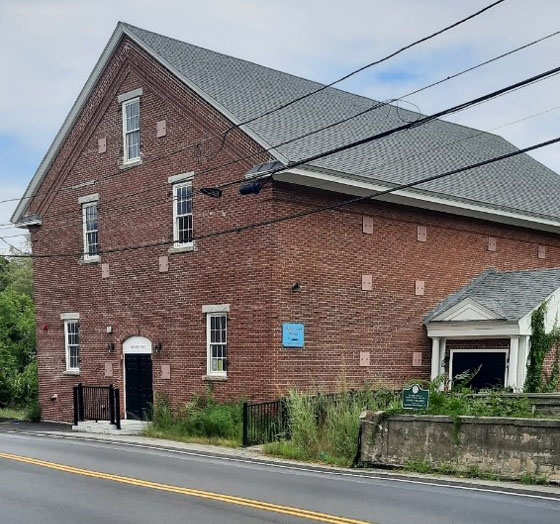 In this photo the signs are in place but the area around the building had not been cleaned-up. |
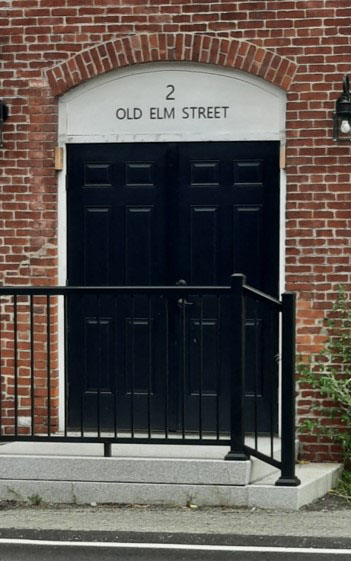 The entrance facing Old Elm Street with new metal signage above the door. |
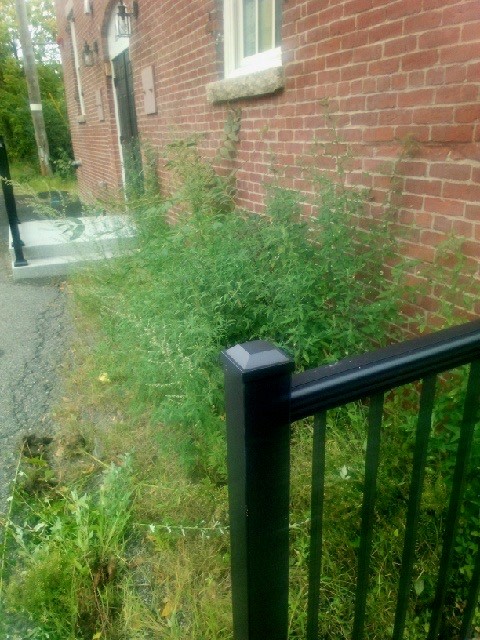
When I was sent a final picture of 2 Old Elm, I was shocked to see so much overgrowth. My yard man, John, spent several hours clearing the front and deck of vines and weeds. Contractor Bill Cogley had two men finish the job. We are very pleased with the end result.
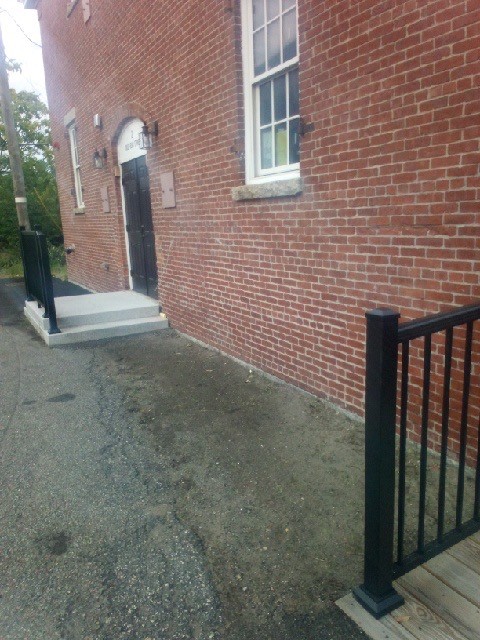 A close up of the weeds around the building in August 2026. |
 Picture after the clean-up was complete. What a difference! |
Commonwealth of Massachusetts
1793. – Chapter 21. [May Session, ch. 21]
AN ACT FOR INCORPORATING JAMES SULLIVAN, ESQUIRE, & OTHERS,
BY THE NAME AND STYLE OF “THE PROPRIETORS OF THE MIDDLESEX CANAL.”
Whereas James Sullivan, Esq. and others have petitioned to be incorporated for the purpose of cutting a Canal from the waters of Merrimack River into the waters of Medford River; And whereas it is represented that sundry persons are ready to raise funds sufficient for the purpose of opening the same Canal;
Be it therefore enacted by the Senate and House of Representatives in General Court assembled that the said, James Sullivan, Oliver Prescott, James Winthrop, Loami Baldwin, Benjamin Hall, Jonathan Porter, Andrew Hall, Ebenezer Hall, Samuel Tufts, junior, Aaron Brown, Willis Hall, Samuel Swan junr. & Ebenezer Hall junr. their Associates and Successors, are hereby incorporated, and shall be a Corporation forever, under the name of the Proprietors of the Middlesex Canal and by that name may sue and prosecute, and be sued and prosecuted, to final judgment and execution, and shall be, and hereby are vested with all the powers and privileges which are by Law incident to Corporations of a similar nature.
And be it further enacted by the authority aforesaid, That the said Proprietors or any three of them may make their application to any Justice of the Peace for the County of Middlesex, requesting him to call a meeting of the said Proprietors to be holden at some convenient place within the Town of Medford, in the same County, whereupon such Justice is hereby empowered to issue his Warrant to one of said Proprietors directing him to warn and notify said Proprietors to meet at such time and place, in said Town of Medford as he shall therein direct, to agree on such method as may be thought proper for calling meetings of said Proprietors for the future, and to do and transact such matters and things, relating to the said Proprietors as shall be expressed in the Warrant, and the Proprietor, to whom such Warrant shall be directed shall give notice to said Proprietors by causing the same or the substance thereof, to be published in one of the Boston News papers, fourteen days before the holding of said meeting and make return thereof, under his hand, to the same meeting to be lodged with the Clerk that shall be then and there chosen. And the said Proprietors may, at the same, or any other legal meeting choose a Clerk, Treasurer, and other officer or officers of the corporation that they may deem necessary, and also may choose a Committee for ordering and regulating the Business and affairs of the said Corporation; and every Proprietor shall have a right to vote in the Proprietary Meetings, according to his share and interest in person or by representation, in the following ratio; vizt. From one hundred to three hundred dollars inclusive, there shall be allowed one vote; from[the] three hundred and one, to six hundred dollars, inclusive, shall be allowed one vote more, and for every thousand, above one thousand, shall be allowed one vote more. Provided no one Proprietor shall have more than twenty votes; all representations to be proved in writing, signed by the person making the same, by special appointment, which shall be filed with, and recorded by the Clerk, and this act and all rules, regulations, and votes of the said Corporation shall be fairly and truly recorded by the said Clerk in a book or books for that purpose to be provided and kept. Provided, that whereas it may be necessary, in the prosecution of the foregoing business, that the property of private persons may (as in the case of highways) be appropriated for the public use, in order that no person may be damaged by the digging and cutting Canals through his land, by removing mills or mill dams, diverting water courses, or flowing his land by the Proprietors aforesaid, without receiving full and adequate compensation therefor; Be it enacted by the authority aforesaid, That in all cases where any person shall be damaged in his property, by the said Proprietors for the purposes aforesaid in manner as is above expressed, or in any other way, & the proprietors aforesaid do not, within twenty days after, being requested thereto, make or tender reasonable satisfaction to the acceptance of the person damaged by them as aforesaid, the person so damaged may apply to the Court of the General Sessions of the peace for the County in which the damage shall have been sustained, to have a Committee appointed by said Court at his own expense, to estimate the damage so done and the said Court are hereby authorized and empowered by warrant, under the seal thereof, upon such application made, if within one year from the time of the damage done as aforesaid, to appoint a Committee of five disinterested freeholders in the same Count, to estimate the damages; which Committee shall give seasonable notice to the persons interested and to the Clerk of the proprietors aforesaid of the time and place of their meeting and they shall be under oath to perform said service according to their best skill and judgment; which having done they or the major part of them shall make return thereof, under their hands and seals, to the next Court of General Sessions of the Peace to be holden in said County after the same service is performed, to the end that the same may be accepted allowed and recorded; and the Committee so empowered are required to estimate the said damage and make return thereof, as aforesaid; and if the estimate of the Committee be accepted by the Court, the Clerk of the Court is hereby authorized and directed on application therefor to issue an execution against the property only of the corporation, or of any individual belonging thereto, for the sum so adjudged in damages; provided the same is not paid within twenty days after the acceptance of said report, and likewise for the cost of the said Committee, and fees of the Court, both to be allowed by the Court, provided the sum of damages estimated by the Committee exceed the sum of damages so tendered; But in case the Proprietors actually tendered to the person complaining, before the complaint was exhibited, a sum as great as that allowed by the Court in damages then nothing to be included in the execution for costs of Committee or Court; The execution to be issued by the Clerk of the Court to be in the same terms, mutatis mutandis, and returnable in the same time as though judgment had been rendered against said Corporation for a like sum in damages on process in the Court of Common Pleas; and if any person find himself aggrieved by the doings of said Committee, in estimating damages, he may apply to said Court of General Sessions of the Peace, provided such application be made to the same Court at the next Session thereof in the same County, after the acceptance of such return; and said Court is empowered to hear and finally determine the same by a Jury under oath to be summoned by the Sheriff or his Deputy for that purpose if the person complaining desires the same or by a Committee if the person complaining and the Proprietors can agree thereon. And if the Jury or Committee agreed on as aforesaid, who are to be under oath, shall not increase the sum of damages, the person complaining shall be at the cost arising on such complaint, to be taxed against him by the said Court, otherwise such cost and increase of damages shall be paid by the Proprietors and execution to issue therefor as aforesaid expressed. And it shall be the duty of such Committee or Jury on application of either of the parties, and reasonable notice given to all persons interested, to determine where and how many Bridges shall be made and maintained by said proprietors over the Canal aforesaid, and how the same shall be constructed and what damages shall be paid by the proprietors for neglecting to make and maintain such Bridges; and the report of such Committee, or verdict of such Jury being returned into the same Court and being allowed and recorded shall be a sufficient bar against any action brought for damages aforesaid, saving only that where the sum of damages is not estimated at a sum in gross for the full satisfaction thereof, but a yearly sum is assessed, in such case the complainant shall be intitled to an action of debt for the recovery of the same so often as the same becomes due, during the continuance of the damage done or suffered as aforesaid, and also for the recovery of the damages, for neglecting to make and maintain the Bridges as often as the same is demandable. Provided that no part of the waters of Shawshine River shall be diverted from their natural course for the purpose aforesaid; & that no dwelling-house shall be removed or water course turned or altered whereon any Mill is erected so as to injure such Mill without license therefor first had and obtained from the Court of General Sessions of the Peace of the County in which such house may stand or through which such water course may pass: And the said Court of Sessions on application made to them by the said proprietors shall observe the same rules as are prescribed by Law when application is made to them for granting a public highway. Provided also that the waters of Merrimack River shall not be so diverted from their natural course as to impede or any way interrupt the water carriage down the Merrimack river to the mouth thereof.
And be it further enacted, That if any person[s] or persons shall wilfully maliciously, and contrary to law take up remove, beat down, dig under, or otherwise damnify any dam, canal or Lock or part thereof, designed for the purposes aforesaid, damnify, carry away or set afloat to be carried away any boards, plank, joist or other timber or materials used or to be used in or about said works or shall be aiding or assisting in any of the trespasses aforesaid, he shall for every such offence forfeit and pay to the proprietors aforesaid, treble such damages as the said Proprietors shall, to the Justice or Court and Jury before whom the trial shall be, make appear that they have sustained by means of the same trespass, to be sued for & recovered in any Court proper to try the same, and such Offender or offenders shall be liable to presentment by the Grand Inquest for said County of Middlesex, for any offence or offences against this law, & on conviction thereof, on such presentment before the Court of General Sessions of the Peace for said County, or before the Supreme Judicial Court, shall be liable to pay a fine, to the use of the Commonwealth of not more than twenty pounds, nor less than five pounds, or be imprisoned for a term not more than three months, nor less than thirty days, at the discretion of the Court before whom the conviction shall be.
And be it enacted by the authority aforesaid, that the Proprietors aforesaid be, and they hereby are authorized and empowered to purchase & hold to them and their successors forever, so much land & real estate as may be necessary for the purposes aforesaid, not exceeding the value of five thousand pounds.
And be it further enacted by the authority aforesaid, that for the purposes of re-imbursing the said Proprietors the money by them expended or to be expended in building and supporting the dams, canals, and locks and clearing the passages necessary for the purposes aforesaid, a toll be, and is hereby granted and established for the sole benefit of the proprietors, according to the rates following; viz; For every ton weight that shall be transported in boats or other Vessels through the said Canal, between the bridge in Medford & Merrimack River, the sum of four pence for each mile -- for all masts, timber & lumber floated on raft or otherwise, through the same Canal, the sum of four pence a ton for each mile.
And be it further Enacted by the authority aforesaid, that there shall be toll gatherers and others, to attend all Locks on said Canal in the day time, and on the same Canal at suitable places, who shall give constant attendance, at their respective stations, during the whole of the season for boats & rafts to pass, and on the toll being paid, shall immediately permit passengers, with their property, to pass the said Locks and Canal:And the said toll shall commence on said Canal, as soon as the same, or any part thereof, shall be compleated, and shall continue forever: Provided that when forty years, from the first opening thereof, are expired, the General Court from thence forward, may regulate the rate of toll, and the same shall be collected in such manner as shall be prescribed to the said Corporation.
And be it further enacted by the authority aforesaid, that if the proprietors aforesaid shall refuse or neglect, for the space of ten years after the passing this Act to build and compleat such Canal, so as, to be passable in manner as aforesaid, then this Act, so far as it respects the same, shall be void, and of none effect.
In SENATE, June 22, 1793.
This bill having had two several readings, passed to be enacted.
SAMUEL PHILLIPS, PresidentIn the HOUSE OF REPRESENTATIVES, June 22, 1793.
This bill having had three several readings, passed to be enacted.
WILLIAM TUDOR, Speaker pro tem.Approved June 22, 1793
John Hancock
MISCELLANY
Back Issues – The first issue of the Middlesex Canal Association newsletter was published in October, 1963. Originally named “Canal News”, the first issue featured a contest to name the newsletter. A year later, the newsletter was renamed “Towpath Topics.” More than 60 years of back issues of Towpath Topics, together with an index to the content of all issues, are also available from our website http://middlesexcanal.org/towpath and http://middlesexcanal.org/towpath/towpathindex.htm. These are an excellent resource for anyone who wishes to learn more about the canal and should be particularly useful for historic researchers.
Estate Planning – To those of you who are making your final arrangements, please remember the Middlesex Canal Association. Your help is vital to our future. Thank you for considering us.
Membership and Dues – There are two categories of membership: Proprietor (voting) and Member (non-voting). Annual dues for “Proprietor” are $25 and for “Member” just $15. Additional contributions are always welcome and gratefully accepted. If interested in becoming a “Proprietor” or a “Member” of the MCA, please mail membership checks to Neil Devins, 28 Burlington Avenue, Wilmington, MA 01887.
Middlesex Canal Association Officers and Directors: http://www.middlesexcanal.org/directors.htm
Museum & Reardon Room Rental – The facility is available at very reasonable rates for private affairs, and for non-profit organizations to hold meetings. The conference room holds up to 60 people and includes access to a kitchen and restrooms. For details and additional information please contact the museum at 978-670-2740.
Museum Shop – Looking for that perfect gift for a Middlesex Canal aficionado? Don’t forget to check out the inventory of canal related books, maps, and other items of general interest available at the museum shop. The store is open weekends from noon to 4:00pm except during holidays.
Web Site – The URL for the Middlesex Canal Association’s web site is www.middlesexcanal.org. Our webmaster, Robert Winters, keeps the site up to date. Events, articles and other information will sometimes appear there before it can get to you through Towpath Topics. Please check the site from time to time for new entries.
The first issue of the Middlesex Canal Association newsletter was published in October, 1963. Originally named Canal News, the first issue featured a contest to name the newsletter. A year later, the newsletter was renamed Towpath Topics.
Towpath Topics is edited and published by Debra Fox, Alec Ingraham, and Robert Winters. Corrections, contributions and ideas for future issues are always welcome.
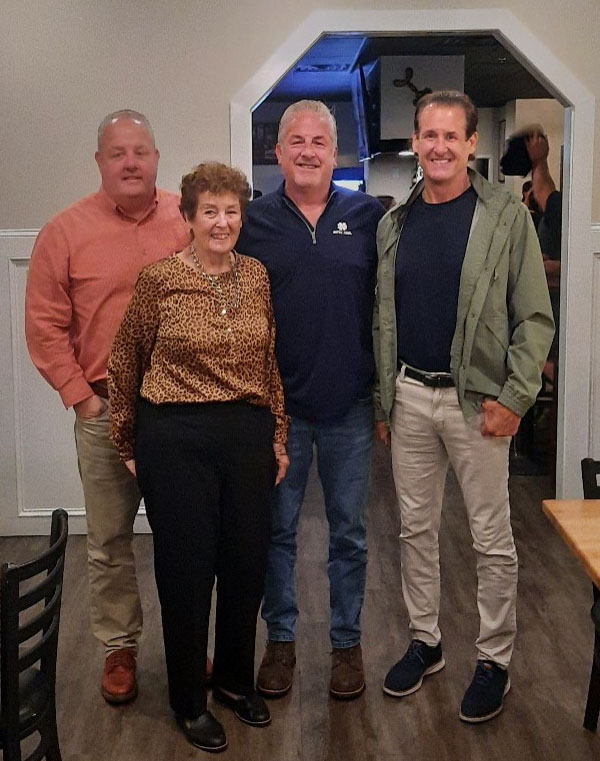
Pictured here are Shayne Reardon and her three sons, Dan, Chris and Sean (l to r) on the 14th year of her husband’s passing on 05/13/2012.
Each year the Reardon family gets together to celebrate the life of Shayne’s husband, John who was a member and chair of the
Middlesex Canal Commission: Billerica Section and who was instrumental in establishing the Middlesex Canal Museum and Visitors Center.